

I’m writing this from my son’s hospital room.
My oldest, he’s four, was admitted the other day for complications from the flu. He’s making a full recovery, praise God. But as I sit here in this chair that doesn’t recline quite right, listening to the nurses moving up and down the hall, and watching his small chest rise and fall under the hospital blanket, I can’t stop looking at my watch.
And I can’t help but wonder: How many times has this watch sat by someone’s bed?
How many hospital rooms?
How many late nights?
How many funerals has it attended?
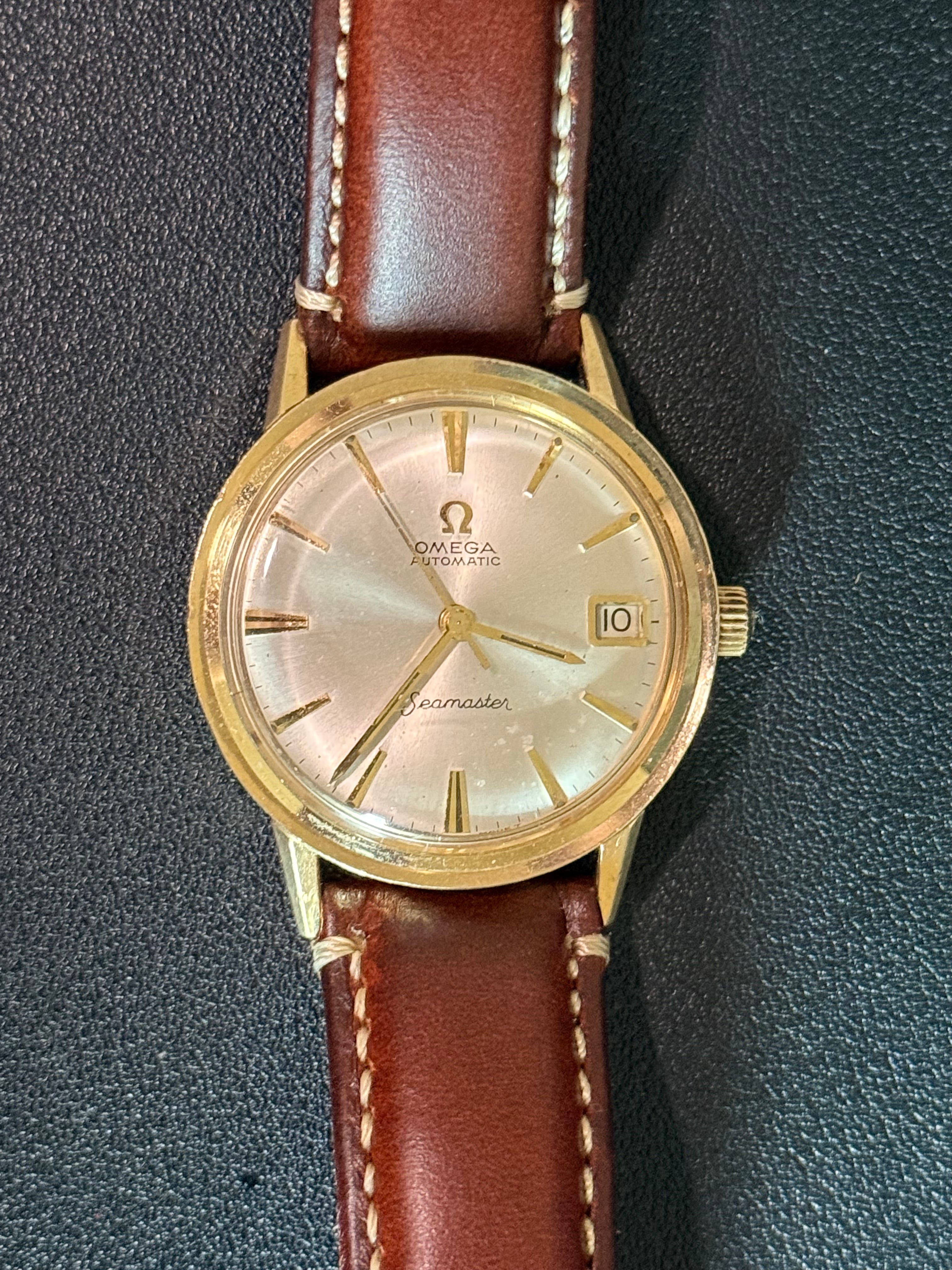
The watch on my wrist is an Omega Seamaster from the mid-1960s. I bought it last month at an antique market in Mount Dora. I’m a sucker for a deal, you see. Maybe it’s the salesman in me, but I will look for a deal everywhere. Even on a good deal you can expect me to try and build in 30% margin. Never hurts to ask, right?
My wife Taylor and I had ventured out early that Saturday morning with both kids in tow. We walked up and down the rows of tables, vintage glasses, figurines, rusty tools, photographs of dead strangers, pouring caramel popcorn into our sons’ cups to keep them compliant. I was hunting. Looking for a vintage watch. Something mechanical. Something with history.
And then I found it.
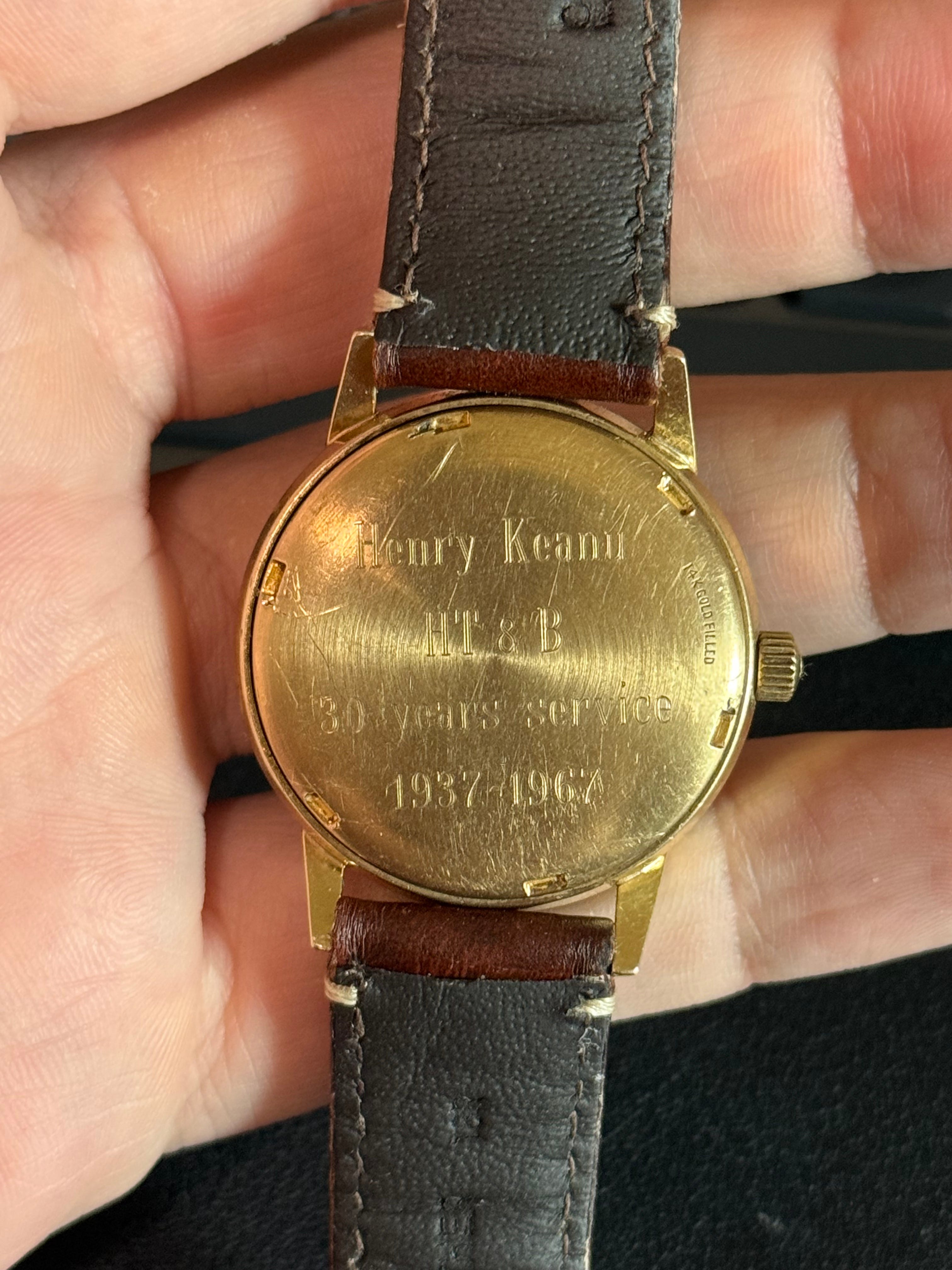
An Omega Seamaster. Gold-capped case, cream dial aging to champagne. Lying on a velvet lined box between a a Casio and some costume jewelry. I picked it up. Felt the weight. Turned it over.
Engraved on the case back:
Henry Keanu
HT&B
30 years service
1937-1967
The mainspring was slack. Silent. But I wound it anyway, after a couple turns it came back to life, and then I heard it. That whisper-thin tick-tick-tick-tick, surprisingly audible even in the relative noise of the event. After years, maybe decades, of sitting dormant, the watch was alive.
“How much?”
The dealer glanced at it, “five hundred.”
I started negotiating. Thirty percent margin, remember? Never hurts to ask.
We settled on five hundred… cant win them all.
Now it’s on my wrist, ticking away, as I sit in this hospital room watching my son sleep off the flu. And I keep thinking about Henry. About the watch sitting on his wrist during his own vigils. His own hospital stays. His own 3 AM moments of wondering if the people he loved would be okay.
Because this watch has been places. Has seen things. Has measured out moments of joy and terror and boredom and grief. For fifty-eight years, this little machine has been ticking through someone’s life. And now it’s ticking through mine.
The Mechanism
Inside the case on my wrist, beneath the now champagne dial and the gold hands and the crystal that’s somehow survived all this time with minimal damage, there are approximately 150 microscopic components engaged in a conspiracy against entropy.
At the heart of it all is the mainspring: a flat ribbon of hardened steel, coiled tight. Right now, because I wound it this morning, that spring is loaded with potential energy. It wants to release all that energy at once. Wants to snap back to its relaxed state in a violent blur. But it can’t.
Because I wound the crown, thirty-seven turns this morning, which connects to a ratchet wheel that coiled the mainspring tighter and tighter. That mainspring connects to a gear train: the center wheel, the third wheel, the fourth wheel. Each one stepping down the torque, translating brute force into something refined, something useful.
The fourth wheel connects to the escape wheel, a tiny gear with precisely angled teeth that looks like a miniature crown.
And here’s where physics holds order.
The escape wheel is controlled by the escapement. Specifically, a lever with two synthetic ruby pallets that alternately lock and release the escape wheel’s teeth. As each tooth escapes from one pallet, it gives the balance wheel a tiny push, like a child on a swing. The balance wheel oscillates back and forth, governed by a hairspring so fine you can barely see it. Five times per second, it oscillates. Each oscillation releases one tooth of the escape wheel.
Tick.
Another tooth escapes.
Tick.
The mainspring unwinds one increment at a time. Its energy is transformed into the measured rotation of hands around a dial. Transformed into time itself. Into this moment and then the next and then the next.
Without the escapement, the mainspring would empty itself in seconds, all its energy wasted in a single violent release. With the escapement, forty turns of the crown gives you forty-eight hours of measured, reliable, relentless ticking. Maybe less after all these years.
Eight beats per second. 28,800 beats per hour. 691,200 beats per day.
Someone’s monitor somewhere beeps every few seconds. His IV drips maybe once per second. His breathing is slower than that pace, maybe twelve breaths per minute now that he’s sleeping peacefully. And my watch ticks eight times per second, faster than all of it, measuring out this evening in increments smaller than his heartbeat.
I keep thinking about Henry.
The Gift
In 1967, someone decided that Henry’s three decades of service warranted something substantial. Something Swiss. Something automatic. I don’t know if the Omega Seamaster wasn’t the obvious choice for a retirement gift. A gold pocket watch would have been traditional. A Rolex would have been flashy. But the Seamaster was something else: modern, technical, sporty. A watch at the time with 30 meters of water resistance, as if Henry might spend his retirement diving for lobsters in the keys.
Maybe he did. I’ll never know.
What I know is this: someone handed Henry a box. Inside was this watch, already ticking, already wound from the automatic movement. Henry lifted it out, I can see it, can’t you? The weight of his retirement heavy on his conscious, the quality of gift maybe surprising him, and he turned it over and read his own name engraved on the case-back and:
“30 years service”
He put it on. Adjusted the bracelet. Felt it tick against his wrist.
He wore it home. Wore it to dinner with his wife, who probably commented that it was handsome, he was maybe thinking about what retirement meant for him, about whether he knew what to do with himself and all this time he just gained. He wore it to bed that first night, or maybe he set it on the nightstand where he could hear it tick in the dark.
Tick. Tick. Tick.
That watch measured out Henry’s mornings. His afternoons. His retirement years.
And I’m sitting here wondering: Did it measure out nights like this one? Did Henry ever sit in a hospital room, watching someone he loved fight off an illness, listening to monitors beep while his watch ticked? Did he ever check the time at 3 AM and think about how many ticks he had left? How many ticks they had left?
Because that’s what I’m thinking about right now.
My son is going to be fine. The doctors are confident. The fluids are working. But sitting here in the flattering flourescent light, listening to him breathe, watching that little chest rise and fall, I’m acutely aware that none of this is guaranteed. That his escapement could have stopped. That mine could stop at any minute. That the watch on my wrist might outlast another owner.
The Mainspring
We are wound.
Not by our own hand, not at first, but we are wound nonetheless. I believe it to be God but I know some of you readers believe it to be a cosmic accident. The physics of life are above my pay grade. But the mechanical reality is undeniable: my son showed up on this planet four years ago with a mainspring already coiled, already loaded with potential energy he didn’t do himself.
And the moment he arrived, that first breath, that first scream, his escapement started ticking.
I was there. Watched it happen. Watched the nurse suction his airways and stimulate his breathing and count his Apgar score while I counted his fingers and toes and tried not to pass out. And then they put him in my arms and we heard that fast, rapid heartbeat that newborns have, ticking away at 140 beats per minute, twice as fast as an adult’s, as if he knew he had so much living to do and needed to get started.
Four years of ticks since then. Four years of that mainspring unwinding. Every breath. Every laugh. Every skinned knee and nightmare and “Dad, watch this!” moment. Every tick bringing him closer to whatever his final number is, and I don’t know what that number is, and sitting here in this hospital room that not-knowing is almost unbearable.
The watch on my wrist will run for forty-eight hours on a full wind. After that, if I don’t move it, if I don’t give it more energy, it stops. The mainspring goes slack. The escapement falls silent. It’s not dead, all those components are still capable of function. but it’s dormant. Waiting.
We’re the same. We wake up every morning needing to be wound. Food and water and purpose and love, we need energy input to keep ticking. My son needs IV fluids right now because the flu stole his energy, emptied his mainspring faster than we could refill it. The doctors are winding him back up, drip by drip.
But here’s the thing: the watch knows exactly how much time it has. Forty-eight hours per winding. We don’t know. Have no idea. Could be eighty years. Could be four years and three days. Could be tonight.
I don’t know. Can’t know.
Henry didn’t know either.
The Tooth That Chips
Mechanical watches fail in predictable ways. The most common failure point is the escapement itself. A tooth on the escape wheel chips, maybe from a shock the watch wasn’t designed to absorb. Or a pivot wears down. Or the pallet stones develop a flat spot where the geometry no longer works.
And when that happens, the watch doesn’t gradually wind down. Doesn’t give you warning. It just stops. Mid-tick. All that remaining mainspring energy still coiled and ready, but with no way to release it.
That’s the thing about the escapement. You don’t know if a tooth might chip. Don’t know which tick might be the last one.
What happened between 1967 and today with Henry? Did he wind this watch every morning for another thirty years, feeling that connection to his career, to his worth, to his identity? Did he wear it to his own children’s bedsides when they were sick? Did he check it during arguments with his wife, watching the seconds tick past while deciding whether to push the point or let it go?
Did it tick against his wrist during his final conscious moments? Did he wear it in his coffin and his wife remove it before his burial?
Or did it sit in a drawer, forgotten? Did Henry put it away after a few years, finding it reminded him of things he wanted to leave behind?
Did he kids sell it off in an estate sale?
Did he fall on hard times and have to sell it for groceries?
Why did it end up in a junker collectors box at an antique show?
Why didn’t his kids keep it after he passed?
Did he have a family?
I don’t know. I’ll never know.
But here’s what I do know: at some point, Henry’s escapement stopped. His escape wheel clicked past the pallet stones for the final time. His mainspring, whatever energy remained, never fully unwound.
And this watch, this beautiful, precise, carefully engineered gift that was meant to honor his life’s work, ended up on a dirty velvet tray in Mount Dora, between costume jewelry and a 10 dollar watch, waiting for some sucker who hunts for deals to wind it back up.
The Hospital Vigil
I wonder how many hospital rooms this watch has seen.
In my head i’ve concocted this tory that Henry was 65 or 70 when he retired in 1967, probably. Which means he was born around 1900, give or take. Which means he lived through the Spanish Flu. Through the Depression. Through two world wars. He lived through the polio epidemics of the ‘40s and ‘50s, when hospitals were full of kids in iron lungs, when parents sat vigil like I’m sitting vigil now, wondering if their children would be okay.
Did Henry sit in rooms like this? Did he watch his own children fight fevers? Did this watch tick on his wrist while he prayed? Was he a believer? Would he have prayed?
The watch doesn’t remember. It just ticks. It measured out those moments for Henry the same way it’s measuring out this moment for me. Impartially. Relentlessly. Eight beats per second, no faster during the good times, no slower during the hard times.
There’s something both cruel and comforting about that.
Cruel because the watch doesn’t care. Doesn’t care that I’m exhausted and worried and my wife hasn’t showered in two days. Doesn’t care that my son is hooked up to an IV and monitors. Doesn’t care that these might be the longest night of my life so far. It just ticks. Tick. Tick. Tick.
But comforting because... it just ticks. It doesn’t speed up with my anxiety. Doesn’t slow down with my dread. It just measures out the time, second by second, beat by beat, reminding me that this moment will pass into the next moment will pass into the next. That the sun will come up. That the fever will break or it won’t. The escapement keeps ticking regardless.
My grandpa one told me that time is God’s gift to us. As I’ve grown up I realize that without it, without the measured passage of moments, we’d be overwhelmed by the eternal present. We’d be crushed by the weight of everything happening all at once. Time, the escapement, gives us the grace of sequence. This happens, then that happens, then the next thing. One tick at a time.
I think he was right.
I’m grateful for the ticks. Grateful that this night is passing one second at a time instead of lasting forever. Grateful that my son’s fever is lower now than it was six hours ago. Grateful that the escapement keeps ticking, keeps measuring, keeps moving us forward from 2:47 to 2:48 to 2:49.
One tick at a time.
I’m going to wind the watch. Show up. Do the work. Try to wind other people’s mainsprings by being present, by being useful, by being a good dad and a good husband.
And when my final tooth chips, when my escape wheel clicks past the pallet stones for the last time, I hope someone picks up the things I built and finds them useful. I hope they wind them up and put them to work. I hope my sons grow up and wind other people’s mainsprings the way Taylor and I wound theirs.
I don’t know Henry’s but I hope he was a believer. I hope after I am greeted by my family in heaven I meet him.
I plan to thank him for the lesson he left behind for this tired dad.
Make today worth a few ticks,
Chance
P.S. I had the watch inspected by a reputable dealer, and I even though I lost the negotiations I have plenty of margin in this deal :)